loader image

Dr. Paul Shoecraft

=

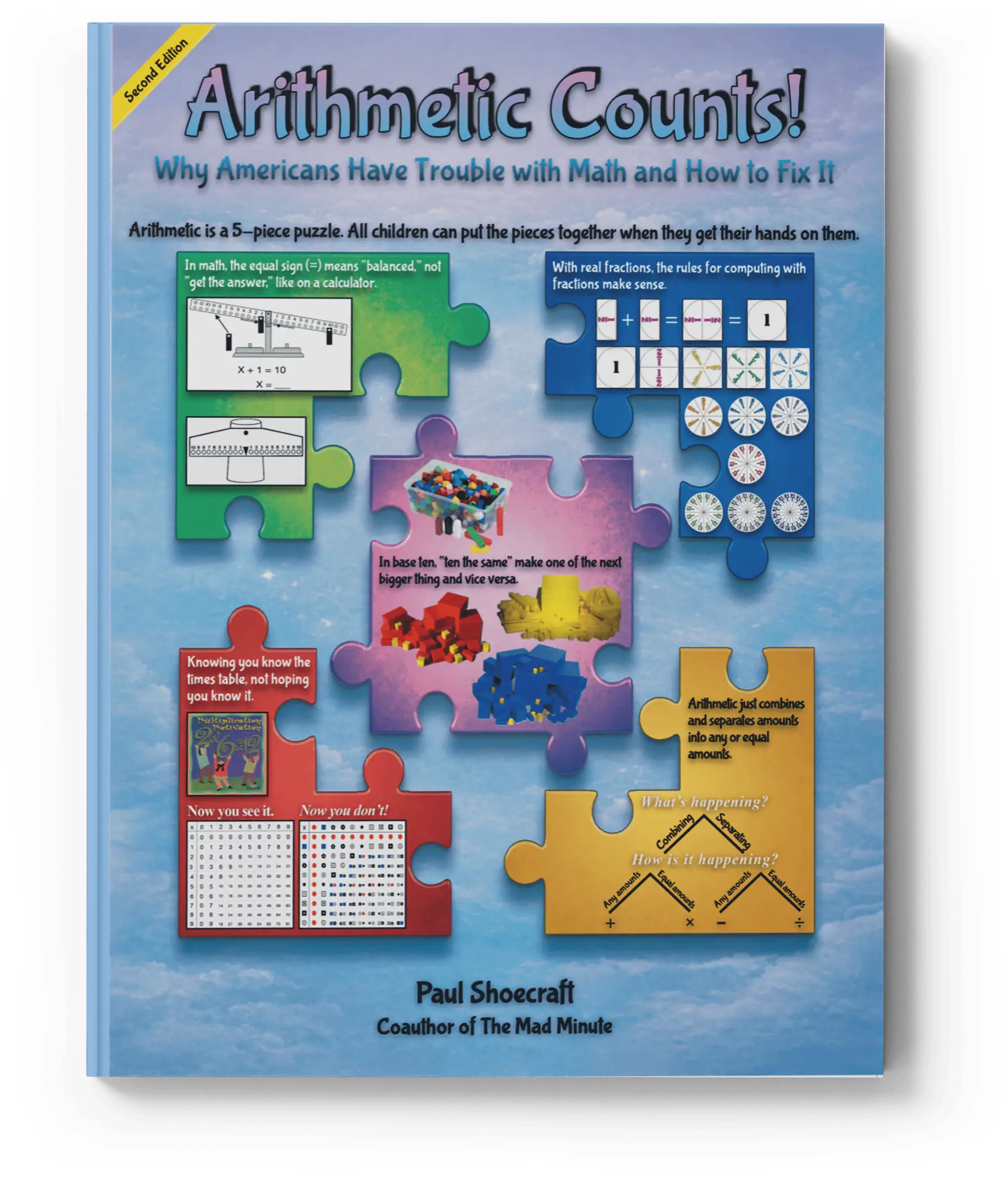
Arithmetic Counts!

What if the biggest obstacle to learning math isn't children's ability—but how arithmetic is being taught?

About the Book

Understanding Arithmetic Starts Here

Dr. Shoecraft may be the only mathematician since the New Math in the 1960s to seriously analyze the “lowly” subject of arithmetic and how to teach it. His breakthrough came when he experimented with teaching what needs to be understood instead of “known” (memorized), like teaching why addition problems until the algorithm they are using supposedly becomes cemented in their brains. By teaching the essence of arithmetic in sensible ways and appealing to children’s love of games, songs, and movement, he’s proven that virtually ALL children can learn arithmetic — the foundation of algebra, higher mathematics, science, technology, and more, even music! When children understand arithmetic, they own it. It’s no lonver just their teacher’s math. It’s their math!

America’s children are being held back in math because of how arithmetic is drug out in elementary school. Virtually every textbook-based elementary school math program in use today is mind-numbing in its repetitiveness from grade to grade. The reason for the redundancy is to slow down the teaching of arithmetic so it can be memorized.

Research shows that the human brain is not designed to remember things learned by rote when no longer practiced. That’s acknowledged in the “use-it-or-lose-it” aphorism that states the obvious, that we remember what we use and forget what we don’t. You know that to be true if you’ve ever forgotten things you once knew as well as your own name — things like an old address or a license plate number.

Every child can understand base ten numeration when taught hands-on with arithmetic blocks. Thereby, every child can understand base ten arithmetic. And every child can learn how to count out the number facts, like 5 + 7 = 12, 17 - 8 = 9, 6 X 7 = 42, and 56 ÷ 7 = 8, and, if they forget one, never have to guess and risk ridicule and bad grades if they guess wrong. What matters in teaching arithmetic is not how much a child can remember but how much they can figure out if/when they forget.

Why Arithmetic Counts?

If you actually read AC, youll realize its importance. For more than a century, mathematicians have claimed that arithmetic must be memorized in order to excel in algebra and higher mathematics. That claim is nonsense and destructive. It's nonsense because it's not true, and it's destructive because it holds children back in math in grades K-3.

America's national K-12 math curriculum, as codified in the Common Core State Standards for Mathematics (2010), restricts the K-3 arithmetic curriculum to just adding and subtracting small numbers while requiring students to memorize the addition and subtraction facts (e.g., 5+8=13 and 15-7=8, respectively) without counting on their fingers. The result is boredom for all, a dislike of math for many, and a poor understanding of numbers among 10 percent of America's adult population, which leads to depression, unemployability, trouble with the law, and even death! (page 246).

America’s children are being held back in math because of how arithmetic is drug out in elementary school. Virtually every textbook-based elementary school math program in use today is mind-numbing in its repetitiveness from grade to grade. The reason for the redundancy is to slow down the teaching of arithmetic so it can be memorized.
Research shows that the human brain is not designed to remember things learned by rote when no longer practiced. That’s acknowledged in the “use-it-or-lose-it” aphorism that states the obvious, that we remember what we use and forget what we don’t. You know that to be true if you’ve ever forgotten things you once knew as well as your own name — things like an old address or a license plate number.

Every child can understand base ten numeration when taught hands-on with arithmetic blocks. Thereby, every child can understand base ten arithmetic. And every child can learn how to count out the number facts, like 5 + 7 = 12, 17 - 8 = 9, 6 X 7 = 42, and 56 ÷ 7 = 8, and, if they forget one, never have to guess and risk ridicule and bad grades if they guess wrong. What matters in teaching arithmetic is not how much a child can remember but how much they can figure out if/when they forget.

Arithmetic Counts presents a tried-and-true, research-based explanation of how to teach arithmetic with whole numbers and fractions that is effective with ALL children. The implications of that are notable: 

"That all kids can learn math implies, of course, that all minorities, all women, all adults — indeed, anyone can learn mathematics. Furthermore, if anyone can learn mathematics, then ability grouping and tracking in school mathematics — arrangements meant to teach more to some, less to others — are obsolete and counterproductive," page 162. 

Ready to Transform the Way Children Learn Math?

Give children the opportunity to build confidence, curiosity, and a lasting understanding of arithmetic—one concept at a time. Get your copy today!.

Send a message

Let's Start the Conversation

Have questions about the book, educational philosophy, speaking opportunities, or classroom applications? We'd love to hear from you. Reach out and join the conversation about helping every child build confidence in mathematics.

© 2026 All Right Reserved | Dr. Paul Shoecraft

!

Dr. Paul Shoecraft

x

Home

Book

Author

Events

Reviews

Contact